Blue, Red, Orange, Green, Yellow: The Complete Guide to Hot Shots Tennis Stages for Kids
What each coloured ball actually means, which age suits each stage, and how kids move from Blue all the way to standard yellow-ball tennis.
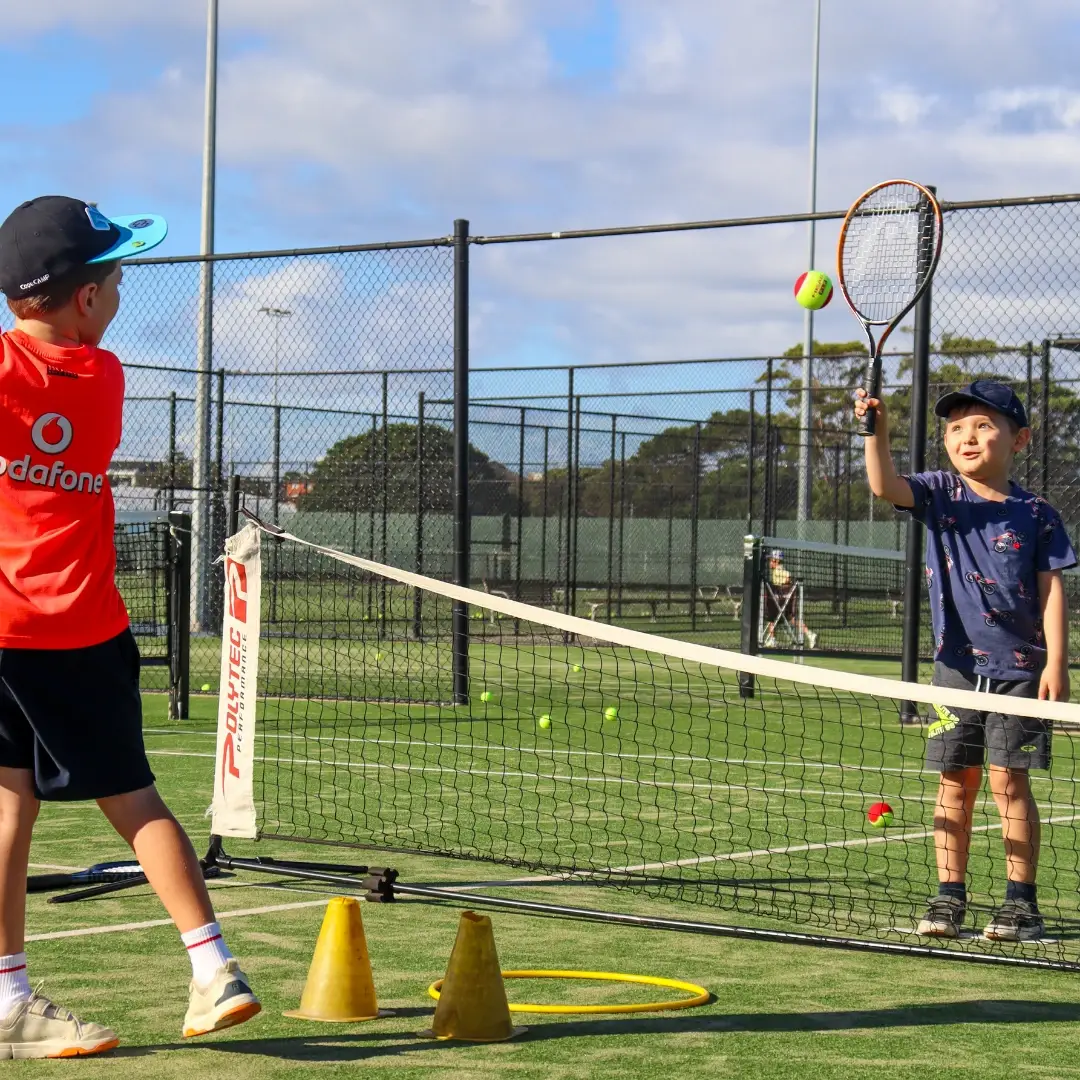
Every week at Scarborough Park, a parent asks us some version of the same question: what does it actually mean when a coach calls their child's group "Orange ball" or "Green stage"? It's not just coaching jargon. It's Tennis Australia's official Hot Shots framework, the same colour-ball, scaled-court system used at accredited clubs across the country, and once you know how it fits together, it's easy to see exactly where your child belongs.
That's true whether you're in Ramsgate Beach, Sans Souci, Kogarah Bay, Sylvania, Monterey, Brighton-Le-Sands or Rockdale: the colour system is the same at every accredited Hot Shots venue, ours included. This guide breaks down what each stage actually means, how long kids typically stay in each one, and what comes after Yellow ball. If you're still deciding whether tennis is the right fit for your child at all, we've also broken down what the evidence actually says.
What Is the Hot Shots Ball Colour System (and Why It Exists)
A full-size tennis court is 23.77 metres long with a net at 91.4cm, hit with a full-pressure yellow ball. That's a genuinely difficult environment for a five or seven-year-old: the ball bounces too high and too fast for a beginner to track, let alone return.
Hot Shots solves this by scaling everything down: a smaller, softer ball with less bounce, a shorter court, a lower net, and a shorter racquet, matched to the age and stage of the child in front of the coach. As kids get stronger and more coordinated, the court gets bigger, the ball gets faster, and the net gets higher, stage by stage, until they're playing on a full court with a standard yellow ball.
The framework was developed by Tennis Australia in line with the International Tennis Federation's global "Play and Stay" approach to junior development, which is why you'll see the same colour-coded stages used at clubs across the country, not just at Scarborough Park. You can read Tennis Australia's own breakdown on their About Hot Shots page.
The 5 Hot Shots Stages Explained
Blue Stage
Ages 3-5+The entry point for the youngest kids, focused on fundamental movement (running, jumping, throwing, catching, striking) in a large, flat, open space with age-appropriate gear. It's less about hitting a "correct" tennis shot and more about building the coordination that every later stage depends on.
Red Stage
Ages 5-8+Kids move onto a scaled court with a soft, low-compression red ball (roughly 25% of full compression) and a 19-23 inch racquet. Red is split into three sub-levels, Red 1, 2 and 3, with the court growing from around 3m x 8.2m up to about 5.5m x 11m. This is where genuine rally skills and simple tactics start to develop.
Orange Stage
Ages 8-10+The ball steps up to 50% compression (same diameter as a standard ball but noticeably softer and slower), racquets grow to 23-25 inches, and the court expands again across Orange 1 and Orange 2. Kids start playing more complex singles and doubles patterns here.
Green Stage
Ages 10+A 75% compression green ball, 25-27 inch racquets, and a court that's close to (or is) full size across Green 1 and Green 2. Green stage is designed to suit two different kids at once: those who want tennis to stay social and fun, and those ready for more competitive match play.
Yellow Ball and Beyond
Standard tennisYellow isn't technically a Hot Shots stage, it's standard tennis: full-pressure ball, full 23.77m court, full net height. Once a child is consistently comfortable at Green stage, the natural next steps are Coloured Ball Competitions and squad-based development, which is where we pick things up in our Squads program at Scarborough Park.
Red vs Orange vs Green Ball Tennis: Quick Comparison
| Stage | Age guide | Ball compression | Racquet length | Court |
|---|---|---|---|---|
| Red | 5-8+ | ~25% (softest, slowest) | 19-23 inch | Smallest, scaled up across Red 1-3 |
| Orange | 8-10+ | ~50% | 23-25 inch | Mid-size, scaled up across Orange 1-2 |
| Green | 10+ | ~75% | 25-27 inch | Near full-size to full-size |
| Yellow | Standard tennis | 100% (full pressure) | 27 inch | Full size (23.77m x 8.23m) |
The short version: the lower the compression percentage, the softer and slower the ball bounces, which is exactly what a smaller player needs to actually track and return it.
How Do I Know What Stage My Child Should Start At?
Age is the starting guide, not the rule. A coach will usually watch a child's first session or trial and adjust based on:
- Existing coordination and ball sense (has this child played any racquet or bat-and-ball sport before?)
- Confidence with movement (running, changing direction, catching)
- Attention span for structured group instruction
This is exactly why we run a free trial lesson before enrolling: it lets our coaches place your child at the stage where they'll be challenged but not overwhelmed, rather than defaulting purely on age.
How Long Does Each Stage Take?
There's no fixed timeline, and any source that gives you an exact number of weeks per stage is guessing. Tennis Australia's own guidance is that progression is skill-based: a child moves up when they can consistently make contact with the ball out in front of their body and start directing it intentionally, not simply because a term has ended.
In practice, some kids move through Red stage in a couple of terms; others benefit from an extra term at Red 2 or Red 3 before Orange, especially if they started Hot Shots at the younger end of the age bracket. That's normal, and it's not a sign a child is "behind."
What Happens After Yellow Ball?
Once a child is comfortable rallying on a full court with a standard yellow ball, two pathways typically open up: Coloured Ball Competitions like our own Hot Shots Challenge for kids who enjoy match play, and squad-based training for kids working toward a more serious competitive pathway. Both build directly on the technical foundation laid during Red, Orange and Green stage, which is why skipping stages tends to create gaps later rather than saving time now.
What I've Seen on Court at Scarborough Park
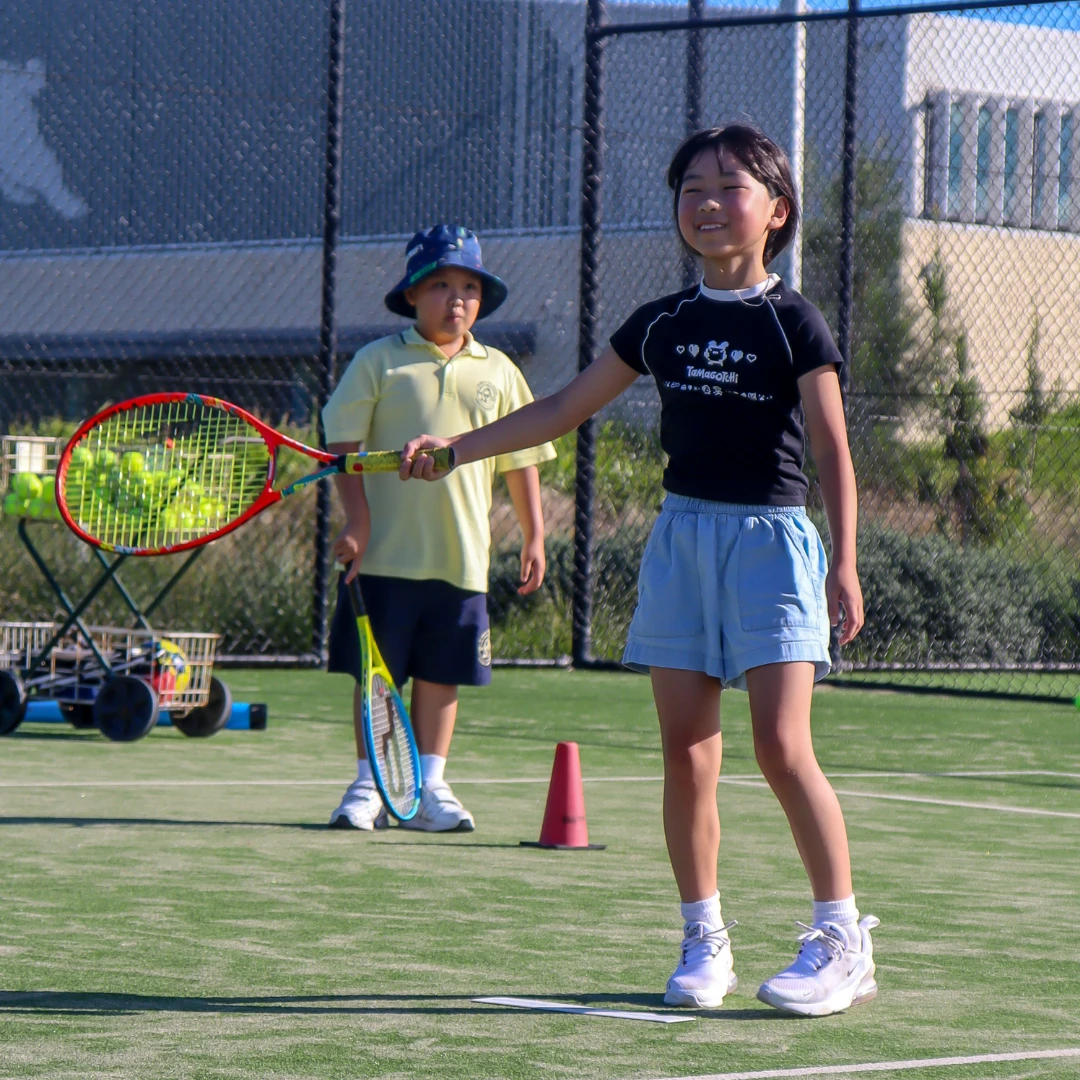
In practice, the biggest thing we watch for isn't which coloured ball a child is "supposed" to be on for their age, it's whether they're still being challenged. We've had five-year-olds who move through Red 1 quickly because they've got strong hand-eye coordination from other sports, and we've had eight-year-olds who benefit from an extra term at Orange 1 before we push them into more competitive doubles patterns. Coaches reassess regularly rather than locking a child into one stage for a whole year, and parents are welcome to ask directly where their child sits and why.
Common Mistakes Parents Make With Stage Progression
- Judging solely by age. Two seven-year-olds can need completely different stages depending on prior coordination and sport experience.
- Pushing to the next ball colour too early. A child who can technically hit the orange ball but can't yet control direction usually plays worse tennis on the bigger court, which can dent confidence.
- Assuming Hot Shots ends at Green stage. Green stage is genuinely the final Hot Shots level; Yellow ball is standard tennis, and that transition deserves its own conversation with a coach, not an assumption.
- Skipping the trial lesson. Placing a child by age alone, without a coach actually watching them move and hit, is the single most common reason for a mismatched first term.
Quick-Start Checklist
- Book a free trial lesson so a coach can watch your child before you commit to a stage.
- Bring any relevant context (other sports, previous tennis experience) to that first session.
- Ask the coach directly which sub-stage (e.g. Red 1 vs Red 3) your child has been placed at, and why.
- Reassess at least once a term, particularly around the Red-to-Orange and Orange-to-Green transitions.
- Once your child is confident at Green stage, ask about Coloured Ball Competitions or the Squads pathway as the next step.
Frequently Asked Questions
What's the difference between red, orange and green ball tennis?
They're progressively less compressed (softer/slower) and used on progressively larger courts: red is roughly 25% compression on the smallest court, orange is 50% on a mid-size court, and green is 75% approaching full-size, preparing a child for a standard yellow ball on a full court.
How do I know what stage my child should start at?
Age (Blue 3-5+, Red 5-8+, Orange 8-10+, Green 10+) is the starting guide, but a coach watching your child's coordination, ball sense and confidence in a trial lesson is the more reliable indicator.
How long does each stage take?
There's no fixed duration. Progression is based on demonstrated skill (consistent contact and directional control), not a set number of weeks or terms.
What happens after Yellow ball?
Yellow ball is standard tennis. From there, kids typically move into Coloured Ball Competitions or a squad-based development pathway.
What age does Hot Shots start?
Blue stage is designed for children as young as 3, focused on foundational movement skills rather than tennis technique specifically.
Is Hot Shots only for beginners?
No. Green stage in particular is designed to suit both recreational kids and those pursuing a more competitive pathway, within the same colour-ball framework.
What racquet size does my child need?
Racquet length is tied to stage, not just age: roughly 19-23 inch for Red, 23-25 inch for Orange, and 25-27 inch for Green, with a full 27 inch racquet for standard yellow ball play.
Can a child skip stages if they're a fast learner?
Coaches assess readiness individually. A strong, coordinated child may move through a stage faster than average, but skipping the underlying skill development (rather than just the time spent) isn't recommended, since gaps tend to surface later.
Do all tennis clubs in Australia use the same stage system?
Yes. Hot Shots is a Tennis Australia program aligned with the International Tennis Federation's global framework, so the colour stages are consistent across accredited clubs nationally.
How do I enrol my child at Scarborough Park?
The easiest first step is a free trial lesson, so our coaches can place your child at the right stage before you commit. Sign up now and get a free trial to get started.
Ready to Find Your Child's Stage?
Not sure which stage is right for your child? Sign up now and get a FREE TRIAL lesson at Scarborough Park Sports Centre, Ramsgate Beach, and let one of our coaches place them at the right level from day one.
Sign Up Now & Get a FREE TRIAL